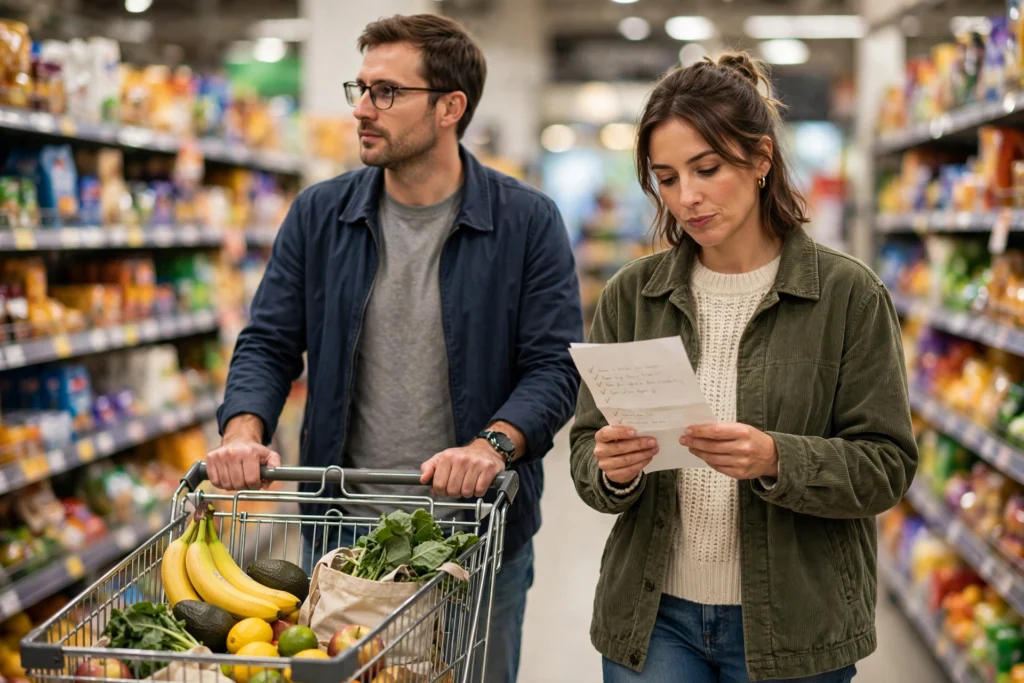
An impulse buy is any item in your cart that was not on your list and not part of your meal plan — something you decided to buy in the moment, in the store, rather than before you left home. Impulse buys are a normal part of shopping, not a character flaw, and nearly every couple has a few on every receipt. The value is in noticing them: once you spot your patterns, you can decide together which extras are worth it.
Key Takeaways
- An impulse buy is defined by timing, not by the item: if the decision happened in the store instead of at home, it was an impulse buy.
- They happen for ordinary reasons — hunger, tiredness, eye-catching displays, tempting sale signs, and vague lists.
- Comparing your receipt with your list for a few shops is the simplest way to spot your household’s patterns.
- Planned treats and forgotten staples are not impulse buys, and treating them as failures helps nobody.
- A small, agreed “extras” allowance turns treats into a plan instead of a source of guilt or friction.
- Impulse buys matter through your shared grocery budget: small extras, repeated weekly, quietly push it over.
In This Guide
- What Counts as an Impulse Buy — and What Does Not
- Why Impulse Buys Happen: The Ordinary Reasons
- How Stores Are Set Up to Catch Your Eye
- How Couples Can Spot Their Own Patterns
- Gentle Habits That Keep the Cart on Plan
- How Impulse Buys Connect to Your Shared Grocery Budget
- A Worked Example: One Couple’s Receipt, Reviewed Without Blame
- Frequently Asked Questions
- Your Next Step
- Related Articles
What Counts as an Impulse Buy — and What Does Not
The definition is simpler than most people expect. An impulse buy is an unplanned purchase made on the spot: you decided while shopping, not beforehand. The same item can be an impulse buy on one trip and a planned purchase on the next. Cookies written on the list for Friday movie night are a plan; the same cookies grabbed at the checkout are an impulse buy. The cookies are identical — the decision is what differs.
The definition matters because couples often argue past each other about it. One partner uses “impulse buy” to mean anything indulgent; the other hears it as an accusation. It is neither. It describes when a decision was made — and decisions made in the moment, in a store designed to encourage them, are less considered than ones made calmly at home.
What impulse buys are not
- A planned treat. If you decided at home that this week’s shop includes ice cream for the weekend, buying it is following the plan, not breaking it.
- A staple you forgot to write down. Realizing in the aisle that you are out of dish soap is your memory working, not your willpower failing — the fix is a better list.
- A genuine substitution. If the fish you planned is unavailable and you choose chicken instead, that is adapting a plan, not abandoning it.
- A one-off celebration purchase. Flowers or a cake for a known occasion is planned spending, even if you picked the item in the store.
Keeping this boundary clear keeps the topic judgment-free: the goal is a cart where the surprises are ones you would have chosen anyway.
Why Impulse Buys Happen: The Ordinary Reasons
Impulse buys are rarely about greed or carelessness. They cluster around a handful of very ordinary conditions, and most couples will recognize all of them.
Shopping hungry or tired
This is the best-known reason: when you shop hungry, food looks better, and more of it looks necessary. Tiredness works similarly — a shop done after a long workday is one where “that looks good” wins arguments it would lose on a Saturday morning. Neither state is a failure; both are worth scheduling around when you can.
A vague list — or no list at all
A list that says “stuff for dinners” leaves every decision to be made in the aisle, under time pressure. The more specific the list — actual meals, ingredients, quantities — the fewer decisions the store makes for you.
“Sale” signs on things you would not otherwise buy
A discount is only a saving if you were going to buy the item anyway; a reduced price on something never in your plan is money spent, not saved. Sale signs are designed to create urgency — to make the decision feel like it must happen now, in this aisle, rather than at home. Buy-one-get-one offers on perishable food deserve a special pause: the second item is only a bargain if your household will use it before it spoils.
Kids’ requests in the moment
Children ask for things in stores. That is part of being a child in a building full of interesting packages. The request itself is not the problem; the absence of an agreed answer is. When parents have not decided in advance, the decision gets made under pressure, in public, with a tired child — and it goes differently every time.
Shopping as a break in itself
Sometimes the grocery trip is the only outing in a busy day, and the cart fills partly because browsing feels like a small pleasure in itself. There is nothing wrong with enjoying a shop. But notice when the trip’s purpose drifts from “get what we planned” to “see what looks appealing” — the second has no natural stopping point.
How Stores Are Set Up to Catch Your Eye
Grocery stores are arranged deliberately, and some arrangements exist to prompt unplanned purchases. This is general, commonly known layout practice. Simply knowing it makes the prompts easier to notice and decline.
- End-of-aisle displays — the stacked displays at the ends of aisles — are designed to catch your eye as you turn corners. Items there are not always on special offer, even when the display suggests they are.
- Checkout displays place small, tempting items — snacks, drinks, small treats — exactly where you stand still with nothing to do but look, when your resolve is lowest.
- Eye-level placement tends to hold the products a store most wants to sell, while plainer or cheaper alternatives often sit higher or lower.
- Seasonal and themed displays group products around holidays, weather, and events, encouraging you to buy for an occasion rather than from a specific plan.
- Cart size matters quietly too: a larger cart makes a modest shop look small and leaves room for “just one more thing.”
None of this makes the store a villain — it means a specific list is how you do your job in return.
How Couples Can Spot Their Own Patterns
Every household’s impulse buys have a signature: particular trips, times, aisles, or shoppers. Finding yours takes one simple exercise, repeated a few times.
The receipt-versus-list check
- For your next three or four regular shops, keep the list you shopped from — a photo of it on your phone is fine.
- When you get home, compare the receipt against the list and mark every item that was not on it.
- For each marked item, sort it honestly: forgotten staple, sensible substitution, planned treat that never got written down, or true impulse buy.
- Look at the true impulse buys as a group: Which trip produced the most? What time of day? Who was shopping? Which part of the store did they come from?
Most couples find a pattern quickly, and common ones look like this:
| What you notice | What it often points to | A gentle response |
|---|---|---|
| Extras cluster on weekday-evening shops | Hunger and tiredness after work | Keep evening trips to a short top-up list; do the main shop at a calmer time |
| Extras come from one aisle or display | A tempting spot on your usual route | Pause consciously there, or let the extras allowance cover it deliberately |
| Extras appear when you shop together | The trip has become an outing | Enjoy the outing — and agree the extras allowance before you go in |
| Extras spike on trips with the kids | No agreed answer to in-store requests | Agree one chosen item per child, decided before entering the store |
Keep the exercise light: the moment it becomes one partner auditing the other, it stops producing honesty and starts producing hidden purchases. You are studying household habits together, not grading each other. The teamwork framing in building a monthly budget as a couple: the complete guide applies here in miniature: shared information, shared decisions, no scorekeeping.
Gentle Habits That Keep the Cart on Plan
Once you know your patterns, a handful of small habits does most of the work. None requires saying no to everything, and the best ones protect the treats you genuinely enjoy.
One written list that both partners add to
Keep a single running list — paper on the fridge, or a shared phone note — that either partner can add to all week, the moment something runs out. A list built over the week is far more accurate than one reconstructed from memory in the car park. Whoever shops works from it; anything genuinely needed gets added without drama.
A meal plan sketch, not a meal plan contract
You do not need a rigid menu. A sketch — four or five dinners for the week, with a flexible night built in — makes the list specific: those meals, plus staples, plus planned treats. The sketch turns “what looks good?” into “what did we decide?”
An agreed extras allowance
This is the habit couples often find most freeing. Agree a small amount per shop, or per week, that is explicitly for unplanned extras — the interesting cheese, the seasonal fruit, the child’s chosen snack. Inside the allowance, extras need no justification and attract no comment. It does not eliminate impulse buys; it gives them a home and a size. Many couples find a planned allowance ends up smaller than the drift it replaced — and more enjoyable.
Small in-store routines
- Eat something before a big shop, or schedule the shop after a meal when the week allows it.
- Agree the answer to kids’ requests before you go in: for example, one chosen item each within the extras allowance; everything else goes on next week’s list if they still want it.
- Do a quick photo-check: a snapshot of the list, or a glance at the shared note before checkout, catches forgotten staples while there is still time.
- Give checkout displays a deliberate miss. If something genuinely appeals, it goes on next week’s list — if you still want it then, it is a planned treat.
- Shopping online for collection or delivery, where available, removes most displays entirely. It suits some households and not others.
These habits work best inside a wider system. If you have not set one up yet, how to get started with a shared grocery budget shows how the list, the meal sketch, and the budget amount fit together.
How Impulse Buys Connect to Your Shared Grocery Budget
Impulse buys matter less as individual items than as a weekly rhythm — a single unplanned item is trivial. But households shop weekly or more, and a similar handful of extras on every trip quietly becomes one of the largest lines in the real grocery spend. That is why couples can follow their list “almost always” and still watch the budget run over: the plan was never the problem — the unplanned layer on top of it was never counted.
Seen that way, impulse buys are the grocery version of the small recurring charges elsewhere in a budget — individually invisible, collectively decisive. Our guide to the subscription and small-purchases audit couples should do once a year treats subscriptions and small purchases as one topic for this reason: the fix is the same — make the invisible layer visible, give it a deliberate size, and review it together.
The goal is not zero: a grocery budget with no room for delight gets abandoned. The goal is a total you chose, extras included, rather than a total that chose you.
A Worked Example: One Couple’s Receipt, Reviewed Without Blame
The amounts below are made-up, round numbers used only as an example. They are not averages or recommendations.
Imagine a couple, Sam and Priya, whose example grocery budget was $600 a month and who kept landing near an example $690 without understanding why. For three shops, they kept their lists and marked their receipts. The gap was an unplanned layer of roughly an example $20 to $25 per shop.
The biggest extras came from weekday-evening shops, which Sam usually did alone on the way home from work, hungry. An example $6 bakery item, an example $8 ready meal upgrade, and an example $5 checkout drink and snack appeared on nearly every evening receipt. Weekend shops together, after breakfast and from a meal sketch, produced only an example $4 of extras. Their daughter’s in-store requests added an example $5 or so on family trips, partly because each parent answered differently.
Their fixes matched their patterns. Evening shops became short top-up trips only — milk, bread, anything on the shared note — with the main shop moved to weekends. They added an extras allowance of an example $10 a shop, inside which the bakery item Sam loved stayed, unbothered. Their daughter got one chosen item per family shop, agreed in advance. A month later their spending sat close to the budget for the first time, and the receipts had stopped being something either of them felt defensive about.
Frequently Asked Questions
Are impulse buys always a waste of money?
No. An impulse buy is only wasteful if, on reflection, you would rather have kept the money than had the item. The problem is the accumulation: unplanned extras, repeated weekly, can push a budget over without either partner making a decision they actually endorsed. Noticing them lets you keep the good ones deliberately.
How can we tell the difference between an impulse buy and something we just forgot to list?
Ask: “Would this have been on the list if we had written it perfectly?” A staple you are out of passes that test — it is a memory slip, and the fix is a better list routine. An item that only entered your thinking when you saw it in the store does not pass, and that is an impulse buy.
What if one partner does most of the shopping and feels blamed for the extras?
Then the framing needs fixing first. The shopper faces the displays, the hunger, and the children’s requests; the partner at home faces none of them, so of course the extras cluster on the shopper’s receipts. Review receipts as household information, never as one person’s report card. Sharing the shopping for a few weeks helps too — partners who take turns develop sympathy for each other’s carts.
Should we just ban unplanned items completely?
A total ban usually backfires: it makes shopping miserable, gets quietly broken, and teaches both partners that the rules are decorative. A small agreed extras allowance works better: treats are permitted, sized, and free of guilt, while the unbounded drift stops. For a stricter season — a tight month, a savings push — agree it as a short experiment with an end date, not a permanent rule.
Does shopping with a list really make a difference if we still add a few things?
Yes, because the list changes the default. Without one, every aisle is an open question. With a specific list built from a meal sketch, the shop has a shape and a finish line, and extras become a conscious addition rather than the method itself.
How do impulse buys fit with a shared grocery budget?
They belong inside it, visibly. Include a realistic line for extras in your grocery amount rather than pretending the month will be perfect — or fold them in and use the receipt-versus-list check until the unplanned layer is small and stable. Either way, the budget should describe your real shopping, extras and all — a budget built on a fiction gets abandoned.
Your Next Step
On your next shop, keep the list — a photo on your phone is enough — and compare it with the receipt when you get home, together. Mark the true impulse buys, notice just one pattern in them, and agree one small habit, whether that is a written shared list, a meal sketch, or a modest extras allowance.
Related Articles
- The subscription and small-purchases audit couples should do once a year
- How to get started with a shared grocery budget
- Building a monthly budget as a couple: the complete guide
This article is for general educational purposes only and is not financial, tax, legal, or investment advice. Consult a licensed professional about your situation.