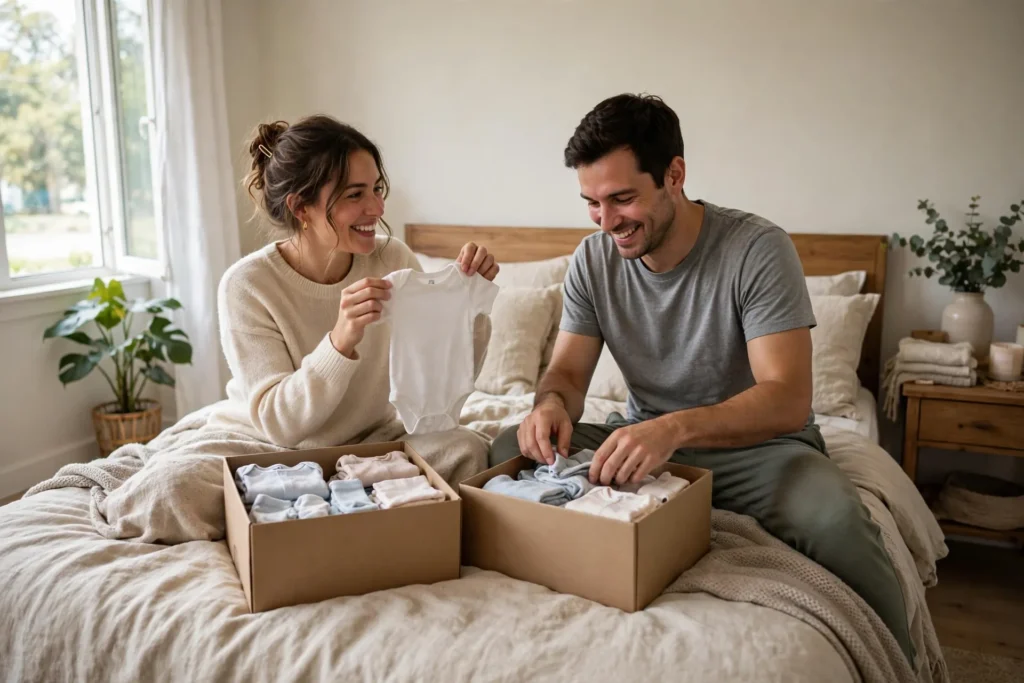
You make hand-me-downs and secondhand gear part of your monthly routine the same way you handle any other regular part of the budget: keep a short, current list of what your child actually needs, set aside a small amount of money for used finds, and spend a few minutes each month checking what has arrived, what still fits, and what can move on to another family. Handled that way, pre-loved clothing and gear stop being a random pile of bags by the door and become a steady, money-saving system that quietly runs in the background of family life.
This guide walks through the routine step by step — the list, the budget line, the monthly rhythm, the family conversations, and the safety checks that matter most with baby and kid gear.
Key Takeaways
- A simple monthly routine turns hand-me-downs and secondhand gear into predictable savings instead of unpredictable clutter.
- Start with a rolling needs list organized by size and season, so you only take in what your child will genuinely use.
- Give used gear its own small line in the monthly budget, and judge every used price against the current new price of the same or a similar item.
- Safety-critical gear — car seats, cribs and sleep items, and helmets — needs extra care: check the manufacturer’s instructions and official recall information, and buy new when you are in any doubt.
- Gratitude plus specifics (“we would love 12-month pajamas”) keeps relatives generous and keeps you from drowning in duplicates.
- Rotating outgrown items out as steadily as new ones come in keeps the system light, tidy, and useful.
In This Guide
- Why a Routine Works Better Than Occasional Big Hunts
- Step 1: Keep a Rolling Needs List
- Step 2: Give Used Gear a Line in the Monthly Budget
- Step 3: Build a Simple Monthly Rhythm
- Step 4: Keep the Family Pipeline Kind and Specific
- Step 5: Inspect, Clean, and Safety-Check Everything
- Step 6: Rotate, Store, and Pass It On
- Frequently Asked Questions
- Your Next Step
- Related Articles
Why a Routine Works Better Than Occasional Big Hunts
Most families handle used gear in bursts. A cousin drops off three bags at once, a neighbor mentions a garage sale, and suddenly a weekend disappears into sorting clothes your child may never wear — while the one thing you actually need, shoes in the next size up, still has to be bought in a hurry at full price. The gear itself is not the problem. The lack of a system is.
A monthly routine flips that around. Needs get identified before they become urgent, so you can say yes to the right offers and pass on the rest without guilt. Small, regular sorting sessions replace overwhelming closet purges. And because the routine is connected to your budget — the same monthly budget you use to plan money for a first baby, from gear to leave to the first-year budget — you can actually see what the habit saves you over time. Secondhand stops being a scramble and becomes one of the calmer, smarter lines in your family finances.
Step 1: Keep a Rolling Needs List
The whole routine rests on one humble tool: a running list of what your child needs now and will need soon. Keep it wherever you will both actually look at it — a note on the fridge, a shared note on your phones, or a page in a household notebook.
Organize the list by size and season rather than by item alone. “Size 2T, winter: warm pajamas, one snowsuit, boots” is far more useful than “more clothes,” because children outgrow things on their own schedule and a perfect item in the wrong season often never gets worn. Note the gaps a season ahead when you can: the month you realize your toddler has no rain boots should ideally be the month before the rainy season, not during it.
Update the list as part of the monthly routine described below. Cross off what has arrived, add what is coming up, and let the list — not generosity, habit, or a good sale — decide what comes into the house. When something is not on the list, the default answer becomes a kind “no thank you,” which protects both your storage space and your relationships.
Step 2: Give Used Gear a Line in the Monthly Budget
Hand-me-downs from family may be free, but a secondhand routine usually still involves some spending: secondhand purchases, laundering, replacement batteries or missing parts, and storage bins. Giving that spending a small, named place in your monthly budget keeps it intentional instead of invisible.
Some couples treat it as a tiny sinking fund. A sinking fund is simply money set aside a little at a time for a cost you know is coming — in this case, the next size up, the next season, the next piece of gear. Even a modest monthly amount means that when a great used stroller or a bundle of next-size clothes appears, the money is ready and you are not raiding the grocery budget.
The other half of this step is learning to judge a used price. Never assume “used” automatically means “good deal.” Before you buy, check the current new price of the same item — or the closest similar item — and compare honestly. Then factor in condition, how long your child will use it, and any extras you would need to buy. Here is an invented round-number example to show the method: imagine a used high chair offered at $40 while the same model sells new today for $120. That is a clear gap in your favor if the chair is complete, clean, and sturdy. Now imagine the same chair offered at $95 with a missing tray you would have to replace — suddenly the “deal” nearly matches buying new, with none of the new-item protections. The numbers are made up; the habit of comparing is the real point.
Step 3: Build a Simple Monthly Rhythm
A routine only works if it is small enough to survive busy months. Most couples find that fifteen to thirty minutes a month is plenty. The rhythm below is a starting point — adjust it to your family’s pace.
| When | What to do | Time it takes |
|---|---|---|
| Once a month | Update the needs list: current sizes, upcoming season, new gaps | About 10 minutes |
| Once a month | Try on or hold up borderline items; move outgrown pieces to the “pass on” bin | About 10 minutes |
| When an offer arrives | Check it against the list; accept, or decline kindly and specifically | A few minutes |
| When you buy used | Compare the asking price with the current new price, inspect, and clean before use | A few minutes per item |
| Every few months | Safety-check stored gear and confirm nothing has been recalled | About 15 minutes |
| Twice a year | Full rotation: swap seasonal bins, donate or pass along the outgrown pile | An hour or so |
Notice what is not on this list: constant shopping. The routine is mostly about looking at what you already have and what is already being offered to you. Buying is the smallest part of it.
Step 4: Keep the Family Pipeline Kind and Specific
For many couples, the main source of hand-me-downs is family — and that pipeline runs on goodwill. Relatives who store boxes of baby clothes for years are doing something generous, and the routine works best when they feel appreciated rather than managed.
Two habits keep the goodwill flowing in a useful direction. The first is simple, prompt gratitude: thank people when items arrive, and if a particular outfit gets worn constantly, say so. Givers love hearing that their things are loved again. The second is gentle specificity. Instead of a general “we take hand-me-downs,” try “we are all set on newborn sizes, but we would be thrilled to have anything in 12-to-18-month winter clothes.” Specifics save your relatives from guessing, save you from storing three snowsuits in the same size, and make it easy for them to feel helpful rather than dumped on or rejected.
When you do need to decline, decline the item, not the person: “This is so kind — we are completely stocked in that size, so please pass it to someone who needs it, and keep us in mind for the next size up.” A clear, warm answer like that protects the relationship and quietly trains the pipeline to bring you what you actually need. If the volume truly becomes unmanageable, our companion checklist of decisions to make before you start can help you set the ground rules together first.
Step 5: Inspect, Clean, and Safety-Check Everything
Every item that enters the rotation gets the same basic treatment: inspect it, clean it, and — for the small category of gear where safety is critical — check it properly.
Start with an ordinary inspection. Look for broken parts, sharp edges, loose screws or wheels, torn straps, missing pieces, and fabric that is worn thin. Wash clothing and washable items before first use, and wipe down hard surfaces. If a piece needs a repair you would not trust completely, let it go — a bargain is not a bargain if it does not work safely.
Then treat safety-critical gear as its own category. Car seats, cribs and other sleep items, and helmets all protect your child in ways you cannot fully inspect with your eyes. Safety standards change over time, products get recalled, and used items come with an unknown history — you generally cannot tell whether a car seat has been in a crash, and many safety items carry expiration dates set by the manufacturer. Before using any secondhand item in this category, read the manufacturer’s instructions, confirm the item is complete and within any date limits the manufacturer sets, and check whether it has been recalled through the official United States safety sources — the Consumer Product Safety Commission, which you can reach through USA.gov. And when you cannot verify an item’s history or condition, the calm rule is simple: buy that category new. The savings on ordinary clothes and toys will more than cover it.
Step 6: Rotate, Store, and Pass It On
The last piece of the routine keeps the system from collapsing under its own success: outgrown items leave at roughly the same pace that new-to-you items arrive. Keep two or three clearly labeled bins — current size, next size up, and pass-on — so sorting takes minutes instead of an afternoon. Storing one size ahead is plenty for most families; storing four sizes ahead is how closets fill with clothes that get forgotten, go out of season, or never fit at the right moment.
Passing things on is part of the pleasure of the system, not just housekeeping. The family that received generously becomes the family that gives generously, and items keep serving children instead of sitting in a garage. Before passing gear along, ask the original giver if they would like anything back — some items are loans in spirit even when nobody said so. Otherwise, send the pass-on bin out during your twice-a-year rotation and enjoy the space it frees up.
Over a year, this quiet cycle — list, budget, check, rotate — becomes almost automatic. That is the real goal: not a single heroic secondhand shopping spree, but a monthly routine that keeps your child clothed and equipped for far less than buying everything new, without clutter, stress, or awkward family moments.
Frequently Asked Questions
How much money will a secondhand routine actually save us?
There is no honest single figure, because it depends entirely on what your child needs, what your family is offered, and prices where you live. The reliable way to find out is to track it yourself for a few months: note what you paid for used items and what the same or similar items would have cost new at the time. Most couples who do this are pleasantly surprised — and you will have your own real number instead of a guess.
How do we start if relatives are already dropping off bags of clothes?
Start with gratitude, then get specific. Thank them warmly, sort what you have against a needs list, keep what fits your child’s upcoming sizes, and kindly redirect the rest — either back, or onward to another family with the giver’s blessing. Then share your current “would love” list so future bags match what you actually need.
Which items should we never accept secondhand?
Be most cautious with gear whose job is safety: car seats, cribs and sleep items, and helmets. Their history is hard or impossible to verify, standards and recalls change, and manufacturers set date limits on some of them. Check the manufacturer’s instructions and official recall information through the Consumer Product Safety Commission (reachable via USA.gov) — and when you cannot verify an item, buy that category new.
What do we do with hand-me-downs in sizes or seasons we cannot use?
Store at most one size ahead if you have room, and only when the season roughly lines up. Everything else should move along quickly — back to the giver, to another family, or to donation — while it is still useful to someone. A stored item your child never wears saved you nothing.
One of us loves secondhand and the other prefers buying new. How do we compromise?
Divide by category rather than arguing item by item. Many couples happily take clothes, books, and everyday toys used, while buying safety gear and a few special items new. Agree on the categories together, set the small monthly gear budget, and revisit after a few months — seeing the actual savings usually softens the debate.
Is it rude to tell family exactly what we need?
Not when it is done with warmth. Most givers would rather hand over something that gets worn every week than something that sits in a bin. A specific, grateful request (“if you still have any 18-month winter pajamas, we would love them”) respects their generosity and their time — and it makes saying a kind “no” to everything else much easier.
Your Next Step
This week, start the rolling needs list: write down your child’s current size, the next size up, and the three or four gaps you can already see in the season ahead. Put the list where both of you — and, when the moment is right, your most generous relatives — can see it. That one page turns every future offer into a quick yes or a kind no, and it is the foundation the whole monthly routine stands on.
Related Articles
- Money prep for a first baby: gear, leave, and the first-year budget
- Hand-me-downs and secondhand gear checklist: what to decide before you start
- Where hand-me-downs and secondhand gear goes wrong for many couples
This article is for general educational purposes only and is not financial, tax, legal, or investment advice. Consult a licensed professional about your situation.