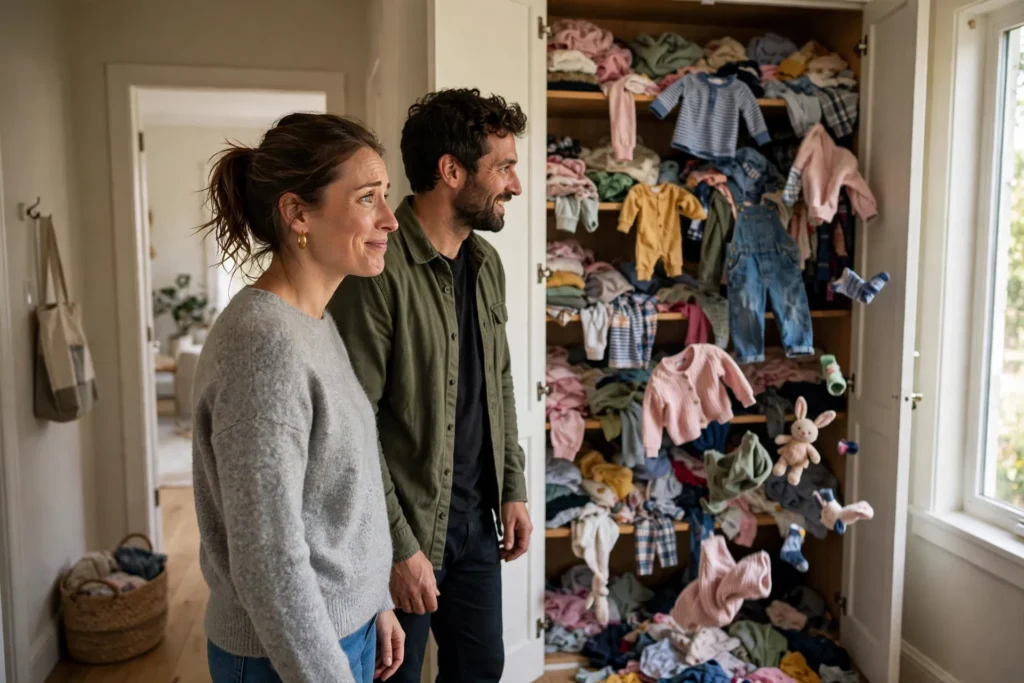
Hand-me-downs and secondhand gear go wrong for couples in a few predictable ways: saying yes to everything until the closets burst, treating safety gear like ordinary gear, paying used prices that are barely below new ones, stockpiling sizes that never get worn, forgetting the hidden costs of cleaning and missing parts, and avoiding one kind conversation until a small awkwardness grows into a family sore spot. None of these mistakes comes from carelessness — they come from deciding in the moment, at the door, without a plan. Each one has a simple fix.
This guide names the mistakes, shows what each one quietly costs you, and gives the calmer alternative, so your household gets the savings of secondhand without the clutter, waste, or tension.
Key Takeaways
- The most common mistake is accepting everything offered; a short needs list turns an automatic yes into a kind, selective one.
- Safety-critical gear — car seats, cribs and sleep items, helmets — is the costly place to get casual: unknown history and changing standards mean some categories should simply be bought new.
- A used price is only a good price compared with the current new price of the same or a similar item; check before you pay.
- Stockpiling future sizes feels thrifty but often wastes the most, because children grow on their own schedule and seasons rarely line up.
- Cleaning, replacement parts, and your own time are real costs of used gear — count them before deciding an item is a bargain.
- Passing items along promptly is part of the system; gear that stops moving becomes storage, and storage becomes stress.
In This Guide
- Mistake 1: Saying Yes to Everything
- Mistake 2: Treating Safety Gear Like Any Other Gear
- Mistake 3: Paying Too Much for Used
- Mistake 4: Stockpiling Sizes That Never Get Worn
- Mistake 5: Ignoring the Hidden Costs
- Mistake 6: Avoiding the Kind Conversation
- Mistake 7: Buying New Duplicates Anyway
- Mistake 8: Letting the Pile Stop Moving
- The Mistakes and Fixes at a Glance
- Frequently Asked Questions
- Your Next Step
- Related Articles
Mistake 1: Saying Yes to Everything
This is the original mistake, the one most of the others grow from. A relative arrives with bags, a friend offers a garage full of gear, and “yes, thank you” comes out before either of you has thought about whether your child needs any of it. The items are free, the giver is kind, and refusing feels rude — so the nursery slowly fills with duplicates, wrong sizes, and things you feel guilty about not using and guiltier about giving away.
The fix is to decide what you need before offers arrive, and to let a written list do the refusing for you. When your household keeps a current list of sizes and gaps — the heart of making hand-me-downs and secondhand gear part of your monthly routine — a decline stops being a personal judgment and becomes a simple fact: “We are completely set in that size.” Free is only free if you use it; an unused item still costs you storage, sorting time, and a small pang of guilt every time you see it.
Mistake 2: Treating Safety Gear Like Any Other Gear
Most hand-me-down mistakes cost money or space. This one can cost more, which is why it deserves its own rule. Items whose whole job is protection — car seats, cribs and other sleep items, and helmets — depend on their history and their exact condition in ways you cannot verify by looking. A car seat may have been in a crash that left no visible mark. Standards and designs change, products are recalled, and manufacturers set expiration dates on some safety items. A bargain in this category is not a bargain at any price if you cannot be sure it will do its job.
The fix is a short buy-new list, agreed in advance, covering the safety-critical categories — and a checking habit for everything borderline. Before using any secondhand item that protects your child, read the manufacturer’s instructions, confirm it is complete and within any dates the manufacturer sets, and check it against the official United States recall information from the Consumer Product Safety Commission, which you can reach through USA.gov. If any part of that check is impossible — unknown age, missing labels, no instructions — the answer defaults to new. Couples who make this decision once, calmly, never have to debate it in a driveway again; our checklist of decisions to make before you start shows how to set the list.
Mistake 3: Paying Too Much for Used
Secondhand feels cheaper by definition, so many couples skip the one step that proves it: checking what the item costs new, today. Sellers price from memory, from what they paid years ago, or from optimism — and popular items in good condition can be listed surprisingly close to their current new price, especially once you add the value of a warranty, a return option, and a full lifespan of use.
The fix is a thirty-second comparison habit. Before paying, look up the current new price of the same item or the closest equivalent, note whether it is on sale, and then judge the used price against condition and remaining life. Here is an invented round-number example to show the shape of the trap: a used stroller is offered at $140 and feels like a steal, until you find the same stroller currently selling new for $160 — at which point the $20 difference is buying you a brand-new item with all its parts and protections, and the used one is barely a deal at all. The figures are made up; the situation is not. “Used” is a description, not a discount, and the comparison is what turns a hopeful price into an informed one.
Mistake 4: Stockpiling Sizes That Never Get Worn
Few feelings are as satisfying as a closet stocked two or three sizes ahead — and few household systems waste as quietly. Children do not grow on a published schedule. A child who is tall in winter may be average by summer; the size you stockpiled for July may fit in November instead, when the shorts and sandals in the bin are exactly wrong. Meanwhile the stored items cannot be used by anyone else, and by the time they are rediscovered they may be out of season, out of style for your child’s tastes, or simply forgotten until they fit no one.
The fix is a one-size-ahead rule. Keep the current size in use and, if you have room, the next size ready — that buffer smooths growth spurts without turning your home into a warehouse. Pass everything beyond that along promptly, while another child can actually wear it in the right season. If a spectacular offer appears in a far-future size, remember this test: a stored item your child never wears saved you nothing, no matter how little it cost.
Mistake 5: Ignoring the Hidden Costs
The price tag on a used item is rarely its full cost. There is the deep clean before first use. The replacement part — the missing stroller tray, the lost puzzle of hardware, the battery cover, the specific screws. The special trip across town to collect it. And your own time, which is the scarcest resource most new parents have, spent sorting, washing, repairing, and storing instead of resting.
The fix is to count the whole cost before you commit, the same way you would for anything in the family budget within your wider first-baby money prep. Ask three quick questions: What will this need before my child can use it? What will those parts, supplies, and trips cost in money and time? And with all of that added, is it still clearly better than buying new or simply doing without? Sometimes the answer is an enthusiastic yes — a wash and a set of batteries is a small price for a sturdy item. Sometimes the honest answer is that the “free” item is the most expensive option on the table. Either way, deciding with the full number in view beats discovering it one errand at a time.
Mistake 6: Avoiding the Kind Conversation
This mistake is emotional rather than financial, and it cuts in both directions. Some couples accept load after load in silence, growing quietly resentful of a relative who only ever meant to help. Others deliver one blunt refusal — “we don’t want used things” — and wound a grandparent who stored those boxes for years as an act of love. In both cases the problem is the same: a conversation that would have been easy early becomes hard late.
The fix is to have the conversation once, warmly, and before it is needed. Thank your regular givers. Tell them what you are looking for — sizes, seasons, the specific gaps — and be honest about your two or three boundaries, including the safety categories you buy new, explained as rules rather than rejections. Most people are relieved to be aimed at what is actually useful. And if you have already accepted too much, it is not too late: a grateful “our closets are officially full — may we pass the extras to a family who needs them now?” resets the system without blaming anyone.
Mistake 7: Buying New Duplicates Anyway
A subtle one: the household diligently accepts hand-me-downs, stores them in bins — and then buys new versions of the same items anyway, because the bins are in the garage, the list is out of date, or in the rush of a shopping trip nobody checked what was already waiting at home. The family pays full price for what it already owns, and the secondhand system gets blamed for “not really saving money.”
The fix is embarrassingly simple: check before you buy. Keep the needs list current, keep stored items visible and labeled by size, and make “look in the bin first” a household habit for both partners, grandparents included when they offer to shop. One glance at a labeled bin has saved more money than many a heroic bargain hunt — and it makes the savings from your used gear show up where they belong, in the budget.
Mistake 8: Letting the Pile Stop Moving
The final mistake happens at the exit door. Outgrown clothes stay in drawers “until I sort them,” the pass-on bin becomes permanent furniture, and gear your child finished with months ago still occupies the corner of the room. The inflow system works beautifully; the outflow never starts. Eventually the clutter itself becomes the argument against hand-me-downs — “this is why we can’t take any more” — when the real problem was simply that nothing ever left.
The fix is to schedule the outflow the way you schedule everything else in the routine: when a size is outgrown, the bin goes out that month — back to the giver if they asked, onward to another family, or to donation. Ask givers their preference once (“would you like things back, or passed along?”) and then move items without a fresh debate each time. A pile that keeps moving makes room for the next round of generosity, and turns your household from a warehouse into what the system was always meant to be: one generous stop in a circle of families helping each other.
The Mistakes and Fixes at a Glance
| Mistake | What it quietly costs | The simpler fix |
|---|---|---|
| Saying yes to everything | Storage, sorting time, and guilt | A current needs list; decline kinds, not people |
| Treating safety gear like ordinary gear | Risk you cannot inspect away | A buy-new list for car seats, sleep items, and helmets; official recall checks |
| Paying too much for used | Nearly new prices for used items | Compare with the current new price before paying |
| Stockpiling future sizes | Clothes never worn, seasons missed | One size ahead maximum; pass the rest along |
| Ignoring hidden costs | Parts, cleaning, trips, and time | Count the full cost before committing |
| Avoiding the kind conversation | Resentment or hurt feelings | One warm conversation: thanks, specifics, boundaries |
| Buying new duplicates anyway | Paying twice for the same item | Check labeled bins before any purchase |
| Letting the pile stop moving | A home that fills instead of flows | Move the outgrown bin out monthly |
Frequently Asked Questions
Is it rude to decline hand-me-downs we do not need?
No — done kindly, it is a favor to everyone. Thank the giver, give the specific reason (you are stocked in that size, or that category is one you buy new for safety), and ask whether they would like the items back or passed to another family. Vague acceptance followed by quiet disposal is far ruder than an honest, warm no.
We have already accepted far too much. How do we reset?
Do one honest sort: keep what fits now and one size ahead, and move everything else out — back to givers who want it, or onward with their blessing. Then start the needs list and the one-size-ahead rule from today. One weekend of sorting buys you a system that never needs a rescue sort again.
How do we know whether a used price is actually fair?
Use the comparison method every time: find the current new price of the same item (or the closest equivalent), check whether it is on sale, then weigh the used price against condition, completeness, and how long your child will use it. If the gap is small, the new item’s protections are usually worth more than the saving.
What if one of us wants to buy everything new for our first baby?
That feeling is common and legitimate — a first baby makes everything feel significant. Try a category compromise: buy the safety items and a few special things new, and take everyday clothing, books, and toys secondhand, where items are outgrown long before they wear out. Revisit after a few months with your actual spending in front of you; the conversation gets easier with real numbers from your own household.
Should we accept gear that will not be used for a year or more?
Usually not, unless it is a timeless, durable item and you genuinely have the storage space. A year is long enough for sizes, seasons, standards, and plans to change — and the same item, passed to a family who needs it now, does real good today. If the offer is from someone who would be hurt by a refusal, accept gracefully, store it labeled, and note it on your list so it is not forgotten.
What should we do with items the giver does not want back and we cannot use?
Pass them along promptly — to another family, a community swap, or a donation point — while they are still in good condition and in season for someone. The one thing not to do is store them indefinitely out of guilt: an item helping another child is the giver’s generosity fulfilled, not wasted.
Your Next Step
Pick the one mistake from this list that your household is closest to making — most couples recognize theirs immediately — and apply its fix this week. Start a needs list, check one used price against its new price, move one outgrown bin out the door, or have the one kind conversation. A single fix, done once, protects all the savings your secondhand system is about to earn you.
Related Articles
- Money prep for a first baby: gear, leave, and the first-year budget
- How to make hand-me-downs and secondhand gear part of your monthly routine
- Hand-me-downs and secondhand gear checklist: what to decide before you start
This article is for general educational purposes only and is not financial, tax, legal, or investment advice. Consult a licensed professional about your situation.