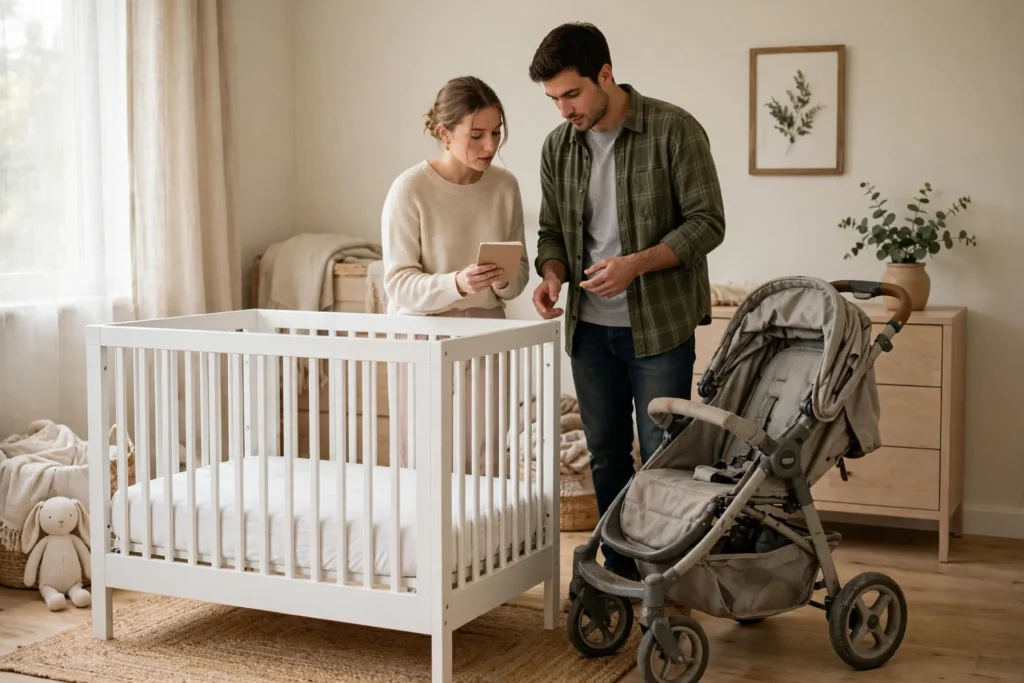
When couples ask what baby gear is worth buying new versus used, the answer depends on the item, not the price tag. Gear whose whole job is safety, or that touches your baby in ways you cannot fully clean or check, is usually worth buying new, while gear your baby will outgrow in a few months and that you can wash and inspect piece by piece is often a smart used buy. This guide gives you a simple three-question test, then applies it category by category so you can decide each item on its own merits.
Key Takeaways
- Safety-critical gear — car seats, cribs and sleep surfaces, and helmets — is the buy-new category for most families, because a used item comes with a history you cannot see.
- Items you can fully wash and inspect, such as clothing, books, and many strollers, are usually the easiest used wins.
- Fast growth changes the math: the shorter the time you will use an item, the more sense a used buy makes.
- “Worth it” is a comparison — the gap between the new and used price, weighed against the risk, wear, and effort involved.
- Whatever the category, check recalls and the manufacturer’s own guidance before using any secondhand item.
- Most couples land on a mix: new for safety, used for almost everything else.
In This Guide
- What “Worth It” Really Means Here
- The Buy-New Side: Safety-Critical Gear
- The Often-New Side: Hygiene and Hard-to-Check Wear
- The Easy Used Wins
- The Middle Ground: Inspect-It-First Gear
- A Simple Way to Compare the Actual Prices
- Frequently Asked Questions
- Your Next Step
- Related Articles
What “Worth It” Really Means Here
Baby gear is worth buying when the value you get from it, over the time you actually use it, justifies what you pay. That sounds obvious, but it changes the question. Instead of asking “which is cheaper?”, you ask “what am I getting for the difference?” A used item that costs a little less but cannot be checked, cleaned, or trusted is not a bargain. A used item that costs a lot less, works exactly as it should, and will be outgrown in one season very often is.
Three questions sort almost every item on a typical baby list. Ask them in order, because the first one can end the discussion on its own.
Question 1: Does This Item Have a Safety Job?
Some gear exists mainly to protect your baby: it restrains them in a moving car, holds them safely while they sleep, or guards their head. If an item’s failure could hurt your child, its history matters as much as its current condition, and history is the one thing a used item cannot show you. That is why the safety question comes first and why it points so strongly toward new.
Question 2: Can I Clean It and Check It Completely?
Some items can be taken apart, washed, and examined until you know exactly what you have. Others have padding, foam, tubing, or inner parts you cannot see or reach. If you can clean a thing fully and inspect every part that matters, used becomes a reasonable option. If you cannot, you are partly buying on trust, and that should shrink what you are willing to pay, or move the item to the new list.
Question 3: How Long Will We Actually Use It?
Babies grow out of gear at a startling pace. Clothing sizes turn over in months, and many seats, swings, and play items have a short window before your child is too big or too mobile for them. A short use window argues for used, because the item does not need to last for years — it needs to last for one brief stage. A long use window, like a crib that converts or a stroller you will push daily for a long stretch, can argue for new, because durability and a known starting condition matter more.
The Buy-New Side: Safety-Critical Gear
Safety standards and product recalls change over time, and used safety gear carries two quiet unknowns: what has happened to it before, and how much of its usable life is left. Many safety products have an expiration or “do not use after” date set by the manufacturer, and a used item may be close to it, past it, or missing the label that would tell you. Before using any secondhand safety item, check the manufacturer’s instructions and the official US safety and recall information from the Consumer Product Safety Commission, which you can reach through USA.gov. And when you are in doubt about a safety item, treat that doubt as your answer and buy that category new.
Car Seats
A car seat is the clearest buy-new item on the list. A used seat may have been in a crash, and damage is not always visible. It may be expired, recalled, missing its labels or instruction manual, or missing pieces. If you ever consider a seat from someone you know, the minimum checks are a complete history you trust, the manufacturer’s date and instructions, all original parts, and a recall check — and many families reasonably decide that even then, new is worth it for the one item whose only job is protecting their child in a collision.
Cribs and Sleep Surfaces
Sleep gear has changed a great deal over the years as safety guidance has evolved, so an older crib or sleep product may not match current guidance. Used sleep items can also be missing hardware, have loose or repaired parts, or lack the instructions needed to assemble them exactly as designed. Check any sleep product against current official guidance and the manufacturer’s instructions, make sure every piece of hardware is present and original, and if anything about it feels uncertain, buy new. This is not the category for “probably fine.”
Helmets
Helmets are made to absorb the force of an impact, and once one has done that job, it may not do it as well again — even if it looks untouched. Because you cannot see a used helmet’s past impacts, a new helmet fitted to your child is the safer default when your child is old enough for activities that call for one.
The Often-New Side: Hygiene and Hard-to-Check Wear
A second group is not exactly safety gear, but it is hard to clean fully or hard to evaluate, which pushes many couples toward new or toward replacing certain parts.
Items that go in your baby’s mouth, and feeding parts made of soft materials, can wear, crack, or hold residue in places you cannot scrub. Some products have parts the manufacturer intends to be replaced periodically, and the manufacturer’s instructions are the place to check what can be swapped out. A used item with fresh, manufacturer-approved replacement parts may be reasonable; the same item as-is often is not.
Mattresses and thick padded items raise a similar issue: you cannot see inside them, and you cannot be sure how they were stored or what they have absorbed. Many couples put crib mattresses on the new list for this reason, which pairs naturally with the sleep-safety guidance above.
Breast pumps deserve a mention because designs differ. Some pumps are made for a single user, while others are built so that each user has their own set of parts that touch milk. The manufacturer of the specific model can tell you which kind it is. If the model is a single-user design, buy new; if it is a shared-motor design, follow the manufacturer’s guidance on which parts must be new for you.
The Easy Used Wins
Now the cheerful side of the list. Plenty of baby gear is durable, washable, and needed for such a short stretch that used makes obvious sense.
Clothing is the classic used win. Baby clothes are often worn only a handful of times before they are outgrown, they wash completely, and you can inspect every seam and snap. Hand-me-downs and used clothing can carry a baby through several sizes at a fraction of the effort of buying everything new.
Books and many toys work well used, as long as they can be cleaned and have no broken pieces, sharp edges, or small parts coming loose. Board books and sturdy plastic or wooden toys that can be washed are easy to evaluate in your hands.
Strollers are often good used buys because they are built sturdily and sold on when another family’s needs change. Inspect the frame, folding mechanism, brakes, harness straps, and wheels, and check that it folds and locks the way the manufacturer’s instructions describe.
Simple furniture and gear — a changing table, a plain dresser, a baby bathtub, a floor play mat you can wash — are usually straightforward to check and clean. If it is solid, stable, complete, and cleanable, it is a good used candidate.
If you are building this whole gear list as part of getting ready for a first baby, our pillar guide on money prep for a first baby, including gear, leave, and the first-year budget shows how the new-versus-used decisions fit into the bigger plan.
The Middle Ground: Inspect-It-First Gear
Between the clear new and clear used categories sits a group that can go either way, depending on what your inspection finds: high chairs, swings and bouncers, baby carriers and wraps, and play yards. These items have straps, latches, buckles, and moving parts that must all work, and their safety depends on correct assembly and use.
For anything in this middle group, run the same short routine. First, find the manufacturer’s instructions — most are available from the manufacturer — and confirm every part the instructions list is present. Second, check the item for recalls through the Consumer Product Safety Commission’s information, reachable via USA.gov. Third, test every strap, buckle, and latch yourself, and look for fraying, cracks, rust, or repairs. Fourth, clean it the way the manufacturer directs. If an item passes all four steps, used is a sensible choice. If it fails any of them, the saving is not worth it, and the item moves to the new list or off your list entirely.
| Item category | Common approach | Check before you decide |
|---|---|---|
| Car seats | Buy new | If ever used: full trusted history, manufacturer’s date, all labels and parts, recall check |
| Cribs and sleep surfaces | Usually new | Current safety guidance, all original hardware, correct assembly, recall check |
| Helmets | Buy new | A used helmet’s impact history cannot be seen |
| Feeding items and soft parts | New, or new replacement parts | Manufacturer’s guidance on which parts to replace |
| Crib mattresses and thick padding | Usually new | You cannot see inside or know how it was stored |
| Clothing, books, sturdy toys | Great used | Wash well; no broken pieces or loose small parts |
| Strollers, high chairs, carriers, play yards | Good used, after inspection | Straps, buckles, brakes, and latches all working; complete parts; recall check |
A Simple Way to Compare the Actual Prices
Once an item passes the safety and inspection questions, the remaining decision is simple arithmetic you do with real listings in front of you, not with guesses. Look up what the item costs new today. Look at the actual used price for the one you are considering. Then ask whether the difference is large enough to justify the unknowns and the effort — driving to pick it up, cleaning it, and living without the option to return it if it is not right.
Here is a purely invented example with round numbers, just to show the shape of the thinking. Imagine a stroller that sells new for $300 and is listed used, in good working order, for $120. The gap is wide, the item is inspectable, and the saving can be redirected to a new car seat. Now imagine a smaller item that sells new for $40 and is listed used for $30. The gap is tiny, the item cannot be cleaned as fully, and new wins easily. Same family, same week, two different answers — because the test, not a blanket rule, is doing the work. If you would like the other side of this comparison, our companion article walks through when buying used helps and when it may not in more depth.
Frequently Asked Questions
Is it ever okay to use a secondhand car seat?
Only with a complete history you genuinely trust: you know where it has been, it has never been in a crash, it is within the manufacturer’s stated use period, all labels, instructions, and parts are present, and it is not under recall. Because any gap in that chain matters, many families decide a new seat is worth it, and that is a reasonable call.
What about a crib handed down from a relative?
Check it carefully before you decide. Confirm it matches current safety guidance, that all original hardware is present and tight, that nothing has been repaired or modified, and that it is not recalled. The manufacturer’s instructions and the Consumer Product Safety Commission’s information, reachable through USA.gov, are your references. If any check fails, thank your relative warmly and buy new.
Can we buy a used breast pump?
It depends on the design. Some pumps are made for a single user; others are built so each user has separate parts that touch milk. Check the manufacturer’s guidance for the specific model. For a single-user model, buy new. For a shared-motor design, use new parts wherever the manufacturer directs.
How do we check whether a used item has been recalled?
Note the item’s maker, model, and any date on its labels, then check the official US recall information from the Consumer Product Safety Commission, which you can reach through USA.gov. The manufacturer can also confirm a model’s status and supply missing instructions. Make this check a habit for every secondhand item, not just the big ones.
If the used price is close to the new price on sale, which should we pick?
New, in most cases. When the saving is small, it does not compensate for the unknown history, the cleaning and checking effort, or the lack of return options. Used shines when the gap is wide and the item is fully inspectable; when the gap narrows, the reasons to buy used mostly disappear.
Which gear do babies outgrow fastest?
Clothing is the fastest-turning category for most families, since sizes change quickly in the first year. Many early-stage items — small swings, bouncers, and some play gear — also have a short window before a baby is too big or too mobile for them. Those short windows are exactly why used versions of these items are so common and so practical.
Your Next Step
This week, take your baby gear list and sort every item into three columns: buy new, buy used, and inspect first. Use the three questions — does it have a safety job, can I clean and check it completely, and how long will we use it — and let the sort, rather than a blanket rule, set your budget. Then price the new column first, because those are the items your used savings are meant to protect.
Related Articles
- Money Prep for a First Baby: Gear, Leave, and the First-Year Budget
- Baby Gear Worth Buying New Versus Used: When It Helps and When It May Not
This article is for general educational purposes only and is not financial, tax, legal, or investment advice. Consult a licensed professional about your situation.