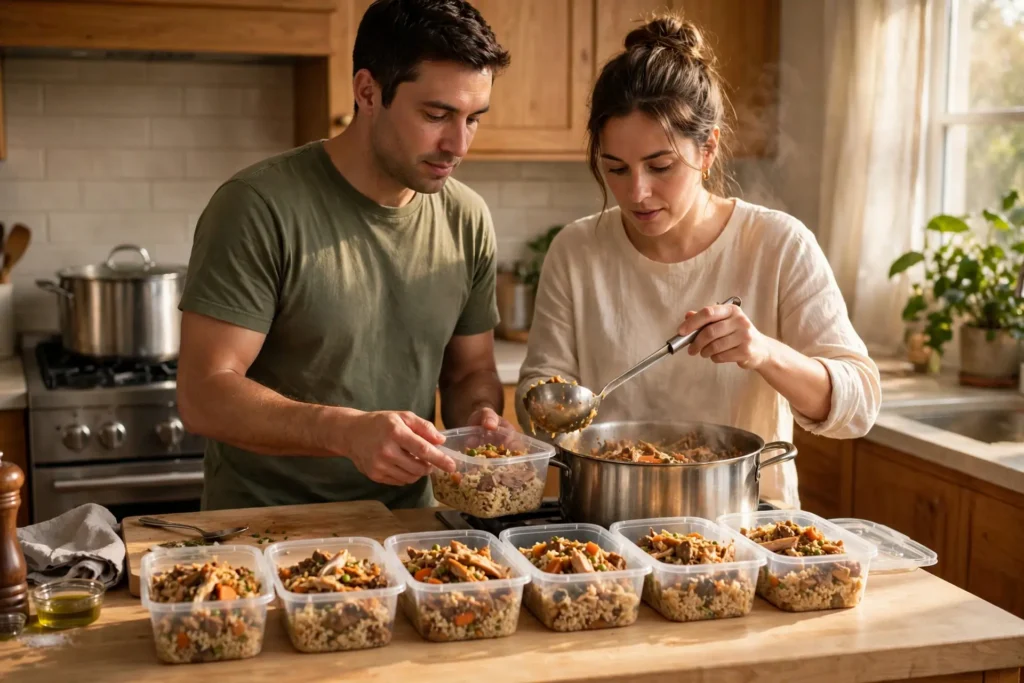
Batch cooking works for busy weeknights when you treat it as a checklist rather than a marathon: choose two or three anchor meals, shop once from a single list, spend one focused session cooking flexible components instead of finished dishes, and store everything safely so weeknight cooking becomes a few minutes of assembly. Split between two people — one plans and shops, the other cooks, or you alternate weeks — a single weekend session can quietly cover most of the week’s dinners. This checklist walks through the whole sequence in order, so the first session runs smoothly and the fifth one feels easy.
Key Takeaways
- Batch cooking means preparing larger amounts of food — or of mix-and-match components like grains, proteins, and sauces — in one session, to be eaten across several meals.
- Components beat finished meals: the same cooked chicken, rice, and roasted vegetables can become bowls, wraps, soups, or stir-fries across the week.
- Safety is part of the system, not an afterthought: cool food promptly, portion it into shallow containers, label it with the date, and refrigerate or freeze it right away.
- Start small — two anchor meals and one session — and let the system grow only after the first version works.
- Split the jobs fairly and rotate roles, so batch cooking does not quietly become one partner’s second job.
- A five-minute review at the end of the week tells you what to cook more of, what to cook less of, and what nobody wants again.
In This Guide
- What Batch Cooking Is — and Is Not
- Step 1: Pick Two or Three Anchor Meals
- Step 2: Check the Pantry, Fridge, and Freezer First
- Step 3: Write One List and Shop Once
- Step 4: Run the Cooking Session in the Right Order
- Step 5: Portion, Label, and Store Food Safely
- Step 6: Turn Components Into Weeknight Meals
- Step 7: Split the Work So It Stays Fair
- Step 8: Finish With a Five-Minute Review
- The Checklist at a Glance
- Frequently Asked Questions
- Your Next Step
- Related Articles
What Batch Cooking Is — and Is Not
An anchor meal is a dish your household likes that can anchor several dinners — and batch cooking, in plain terms, is cooking with that idea at scale: one planned session that produces the building blocks for most of a week’s eating. It is not cooking seven identical dinners and lining them up in matching containers, unless your household genuinely enjoys that. It is not a restaurant-style production, and it does not require a huge kitchen, a second freezer, or a free Sunday. It also is not the same as accidental leftovers. Leftovers are what remain; a batch is cooked on purpose, in the quantities the week’s plan actually needs, which is why a modest session can outperform a heroic one — nothing is cooked just to be thrown away.
Step 1: Pick Two or Three Anchor Meals
Start the checklist where every good session starts: with the menu, chosen together. Pick two or three anchor meals your household already likes — a soup or chili, a grain bowl combination, a pasta bake, a sheet-pan dinner — and favor meals that share ingredients, so one bag of vegetables or one batch of grains serves several dishes. Write down, for each anchor, which components it needs: a grain, a protein, vegetables, a sauce or seasoning. Meals built from components forgive real life; if Tuesday runs late, the components still combine into something fast.
Resist the urge to plan five anchors in week one. Two anchors plus your pantry staples will cover more weeknights than you expect, and an overloaded first session is the most common reason couples quit. You can add a third or fourth anchor once the routine is boring — boring, here, is the sign it is working.
Step 2: Check the Pantry, Fridge, and Freezer First
Before any list gets written, look at what you already own. Check the pantry for the staple bases your anchors need — grains, beans, canned tomatoes, oils, and seasonings — and check the fridge and freezer for proteins and vegetables that should be used soon. This ten-minute look does two jobs: it shrinks the shopping list to genuine gaps, and it moves older food into the plan while it is still good. It is the same inventory habit that anchors meal planning on a family budget: the plan starts from your shelves, not from the store’s.
Step 3: Write One List and Shop Once
Turn the anchor components and the gaps from Step 2 into one shopping list, organized by the order you walk the store — produce, proteins, dairy and eggs, dry goods, frozen — so a single trip covers everything. Note quantities against the plan, not against optimism: if the week needs two onions, the list says two onions. One partner can shop while the other starts prep at home, or you can shop together and split the list in the store. Either way, one trip is the goal; the midweek “quick run” for a forgotten ingredient is where both the money and the calm leak out of the system.
Step 4: Run the Cooking Session in the Right Order
On cooking day, sequence matters more than speed. Start with whatever takes longest and needs the least attention — grains in a pot, beans simmering, a tray of vegetables roasting — then move to active cooking like browning proteins or building a sauce while those run. While things cook, wash and chop the raw ingredients for the week’s salads and assemblies, and wash dishes in the gaps so the session does not end in a mountain. Two people working this way divide naturally: one tends the stove, the other preps, portions, and cleans as you go.
Keep basic kitchen hygiene in the routine without making a ceremony of it: wash hands before starting and after handling raw meat, keep raw proteins and their juices away from ready-to-eat foods, use separate boards for raw meat and produce, and clean surfaces as you finish with them. These are habits, not extra steps, and they are what make food cooked on Sunday safe to enjoy on Wednesday.
Step 5: Portion, Label, and Store Food Safely
Storage is where batch cooking succeeds or fails, so treat this step as part of cooking, not cleanup. As each component finishes, portion it into shallow, lidded containers — shallow portions cool faster and more evenly than one deep pot — and let food cool only briefly before refrigerating or freezing it; cooked food should not sit out at room temperature for long stretches. Label every container with what it is and the date it was cooked, in plain marker on tape. A label takes five seconds and removes the two classic batch-cooking failures: mystery containers nobody dares to open, and good food forgotten past its best days.
Freeze in the portions you will actually use — one meal’s worth per container for most components — so you thaw a dinner, not a brick. Storage times, safe refrigerator and freezer temperatures, and reheating guidance are set by official food-safety sources and do change; USA.gov is a reliable plain-language starting point for the current recommendations, so check there rather than relying on habit or hearsay. The durable rules of thumb are simple: refrigerate promptly, keep the fridge cold, reheat leftovers until they are steaming hot all the way through, and when in doubt about a container’s age or condition, throw it out. No saved ingredient is worth a sick household.
Step 6: Turn Components Into Weeknight Meals
With components stored, write the week’s rotation on the fridge so weeknight cooking is assembly, not decision-making. The example below is invented for illustration — your meals, quantities, and schedule will be your own — but it shows how two anchors and a few components cover five nights without repeating a plate:
| Night | Meal | Built from |
|---|---|---|
| Monday | Chili over rice | Batch chili + batch rice |
| Tuesday | Grain bowls | Batch rice + roasted vegetables + sauce, topped with an egg |
| Wednesday | Chili wraps with a quick salad | Leftover chili + tortillas + fresh greens |
| Thursday | Fried rice | Remaining rice and vegetables, cooked fresh in minutes |
| Friday | Soup-and-sandwich night | A frozen portion of soup from an earlier batch + simple sandwiches |
Notice what the rotation does: the same cooked components appear in different forms, one night is deliberately almost no cooking at all, and the freezer contributes one meal built by a past session. That variety — not willpower — is what keeps a household from rebelling against its own meal plan by Wednesday.
Step 7: Split the Work So It Stays Fair
Batch cooking concentrates household work into one visible block, which makes it easier to share fairly — if you share it on purpose. Divide the system into roles: planning the anchors, writing the list, shopping, cooking, portioning and storing, weeknight assembly, and cleanup. Then assign and rotate them. One workable pattern is that one partner plans and shops while the other leads cooking and storage, and you swap every week; another is doing the session side by side and alternating who handles weeknight assembly. What matters is that the invisible parts — planning and listing — count as work in the split, because they are.
Step 8: Finish With a Five-Minute Review
At the end of the week, take five minutes together: What ran out by Wednesday? What is still sitting in the fridge, and why — too much cooked, or a meal nobody was excited about? What should next week’s anchors be? Write the answers directly onto next week’s plan. Quantities are the usual fix: most couples find they cook one component too generously and another too scantily for the first few sessions, and the review is how the amounts quietly correct themselves. Skipping this step is how a good system slowly drifts into the same two complaints and then gets abandoned.
The Checklist at a Glance
| Step | Task | Done when |
|---|---|---|
| 1 | Pick two or three anchor meals that share ingredients | Each anchor’s components are written down |
| 2 | Check pantry, fridge, and freezer | Older items are in the plan; gaps are known |
| 3 | Write one list and shop once | Everything for the week is in the house |
| 4 | Cook in order: longest and least-attended items first | All components are cooked |
| 5 | Portion into shallow containers, label with date, refrigerate or freeze promptly | No unlabeled or mystery containers |
| 6 | Post the week’s rotation on the fridge | Every weeknight has an assigned meal |
| 7 | Confirm roles for the week and next session | Both partners know their jobs |
| 8 | Five-minute end-of-week review | Notes are written on next week’s plan |
Frequently Asked Questions
How long does a batch cooking session take?
There is no single right length — it depends on how many components you cook and how practiced the routine is. A sensible starting point for a first session is modest: two anchor meals and a time box you both agree to, even if that means covering only two or three weeknights the first week. Sessions get faster as the sequence becomes familiar, and a system that fits inside your weekend will still be running in three months, which matters more than one giant session that never repeats.
Is it safe to eat food cooked several days earlier?
It can be, when the food was cooled and refrigerated promptly, stored in clean containers, kept in a properly cold fridge, and reheated until steaming hot. Official storage guidance — including how many days different foods keep — is updated over time, so check the current recommendations through USA.gov and follow them rather than guessing. And keep the oldest rule of the kitchen: if a container’s age or condition is in doubt, throw it out.
Which foods batch well, and which do not?
Sturdy foods are the backbone: soups, stews, chilis, cooked grains, beans, roasted root vegetables, and sauces generally store and reheat well and often taste better the next day. Foods that suffer are the crispy and the delicate — fried coatings go soft, dressed salads wilt, and some seafood and soft vegetables lose their texture quickly. Cook those fresh on the night, and let the batch carry everything around them.
Do we need special containers or a big freezer?
No. Any clean, food-safe containers with lids that seal will do, including the plain reusable kind most households already own, and a standard fridge freezer handles a two-anchor system comfortably if you freeze in meal-sized portions. Start with what you have. If the system sticks and you later want more containers or better labels, that is a small, earned upgrade — not a starting requirement.
What if one of us hates eating the same thing twice?
That is exactly why this checklist cooks components instead of finished meals. The same batch of grains, beans, and roasted vegetables can be a bowl on Monday, a wrap on Wednesday, and a soup on Friday with nobody eating an identical plate twice. Freezing portions also breaks repetition: a container frozen this week can reappear two weeks later as an easy night, long after anyone is tired of it.
How do we keep the session from taking over the whole weekend?
Cap it and shrink it. Choose a time box, pick two anchors instead of four, and let pantry staples and one frozen portion from a previous week carry the remaining nights. Doing the session together, with roles split, roughly halves the clock time for most households — and remember that the goal is calmer weeknights, not an impressive Sunday. A smaller system that survives busy weekends beats a perfect one that collapses by week three.
Your Next Step
This weekend, pick just two anchor meals together, run the checklist once at that small size, and post the week’s rotation on the fridge. Then hold the five-minute review before you plan the next session — two honest sessions will teach you your household’s right quantities faster than any guide can.
Related Articles
- Meal planning on a family budget: a weekly system from list to leftovers
- Batch cooking for busy weeknights: when it helps and when it may not
- Where batch cooking for busy weeknights goes wrong for many couples
This article is for general educational purposes only and is not financial, tax, legal, or investment advice. Consult a licensed professional about your situation.